
NCERT Class 1 Mathematics Joyful-Mathematics (Sanskrit): Chapter 6 — सब्ज़ियों की खेती
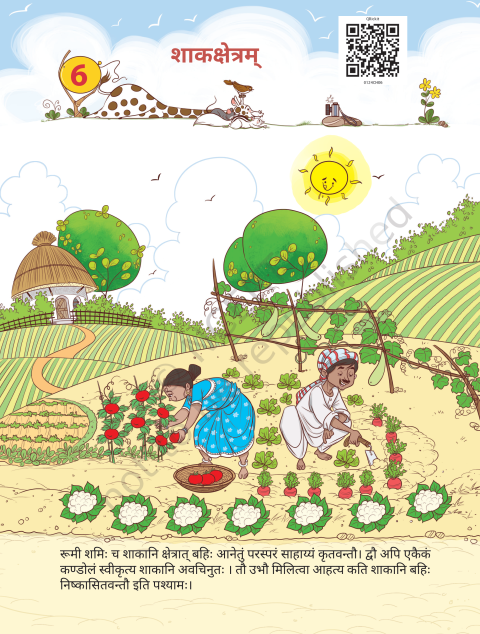
This chapter, "सब्ज़ियों की खेती" (Vegetable Garden), from NCERT's Joyful Mathematics for Class 1 in Sanskrit, introduces basic addition concepts through a relatable scenario. Rumi and Shami collect vegetables from a garden, using baskets to gather them. The chapter presents simple addition problems involving counting vegetables like 'वार्तक्यः' (tomatoes/berries) and 'गृञ्जनकानि' (carrots/radishes), and 'मूलकानि' (radishes/turnips). For instance, it shows how 7 and 5 make 12, and 9 and 4 make 13, and 8 and 8 make 16. A project activity encourages students to plant vegetable saplings at home or school, share their experiences, and observe plant growth, fostering a connection with nature and practical learning.
Quick info
| Board | CBSE / NCERT |
|---|---|
| Class | Class 1 |
| Subject | Mathematics |
| Book | Joyful-Mathematics (Sanskrit) |
| Chapter | Chapter 6 — सब्ज़ियों की खेती |
| Language | Sanskrit |
| PDF type | NCERT Textbook |
| Session | CBSE 2026 |
| Reading time | 1 minute |
| Word count | 125 |
Learning outcomes
- Understand basic addition through real-life examples.
- Solve simple addition problems involving counting objects.
- Develop observation skills by planting and caring for plants.
- Engage in practical learning through a project activity.
Vocabulary
| Word | Meaning |
|---|---|
| सब्ज़ियों की खेती | Vegetable garden |
| कण्डोलं | Basket |
| शाकानि | Vegetables |
| अवचिनुतः | Pluck/Gather |
| वार्तक्यः | Tomatoes/Berries (contextual) |
| गृञ्जनकानि | Carrots/Radishes (contextual) |
| मूलकानि | Radishes/Turnips (contextual) |
| परियोजनाकार्यम | Project work |
| पादपानि | Plants/Saplings |
| रोपयन्तु | Plant |
The complete chapter text is read in the official NCERT PDF viewer below (streamed from ncert.nic.in). This page provides NCERT Help study material — summary, vocabulary, practice questions, and FAQs — not a full reproduction of the textbook.
Read chapter online
This PDF is loaded from the official NCERT website (ncert.nic.in). Use the page buttons below to read — download is disabled on NCERT Help.
PDF preview loads when you scroll to this section (saves data and speeds up the page). Uses full mobile width; tap the full-page icon beside the page controls for landscape reading when supported.
Practice questions
- रूम्याः कण्डोले कति वार्तक्यः आसन्? Answer: 7 वार्तक्यः
- शमेः कण्डोले कति वार्तक्यः आसन्? Answer: 5 वार्तक्यः
- उभयोः कण्डोलयोः मिलित्वा कति वार्तक्यः अभवन्? Answer: 12 वार्तक्यः
- यदि एकस्मिन् कण्डोले 9 गृञ्जनकानि अन्यस्मिन् च 4 गृञ्जनकानि सन्ति, तर्हि कुलानि कति गृञ्जनकानि सन्ति? Answer: 13 गृञ्जनकानि
- 8 मूलकानि + 8 मूलकानि = ? Answer: 16 मूलकानि
Frequently asked questions
What is the main theme of NCERT Class 1 Mathematics Chapter 6, "सब्ज़ियों की खेती"?
The chapter focuses on basic addition concepts using the context of a vegetable garden and collecting vegetables.
What mathematical operations are taught in this chapter?
The chapter primarily teaches simple addition through examples like 7+5, 9+4, and 8+8.
What is the project activity suggested in the chapter?
Students are encouraged to plant vegetable saplings, share their experiences, and observe plant growth.
What kind of vegetables are mentioned in the chapter?
The chapter mentions 'वार्तक्यः' (tomatoes/berries), 'गृञ्जनकानि' (carrots/radishes), and 'मूलकानि' (radishes/turnips) in its examples.
What is the purpose of the project activity in "सब्ज़ियों की खेती"?
The project aims to connect students with nature, promote practical learning, and encourage observation skills.
Important topics
Topics covered
NCERT Class 1 Mathematics — Joyful-Mathematics (Sanskrit) — Chapter 6 — सब्ज़ियों की खेती. Verified by NCERT Help Editorial Team. Reviewed on 29 Jul 2026. Last updated 10 Aug 2026.