
NCERT Class 1 Mathematics Joyful-Mathematics (Sanskrit): Chapter 11 — कितनी बार?
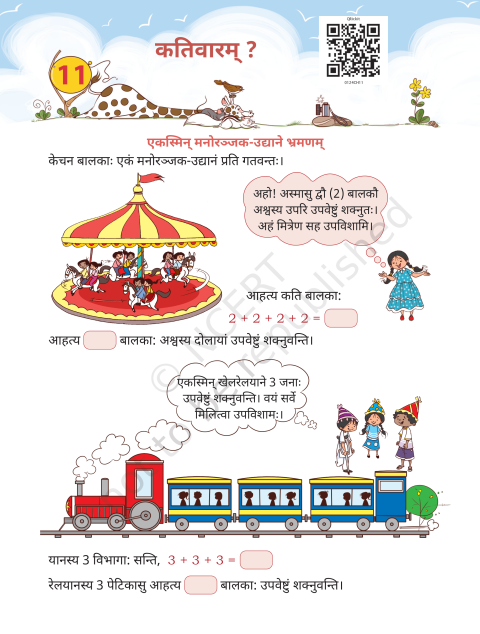
This chapter, 'कतिवारम्?' (How Many Times?) from NCERT's Joyful Mathematics for Class 1, introduces the concept of multiplication through repeated addition. It uses engaging scenarios in a fun park, like children riding a horse carousel and a toy train, to illustrate how to count items when they are grouped together multiple times. For instance, if a toy train has 3 compartments and each can hold 3 children, the chapter guides students to find the total number of children by adding 3+3+3. Similarly, it explores how many children can fit in a Ferris wheel with 5 boxes, each holding 4 children, by calculating 4+4+4+4. The chapter also touches upon calculating the total number of jalebis when 6 boxes are ordered, each containing 3 jalebis, through repeated addition (3+3+3+3+3+3). This chapter aims to build a foundational understanding of multiplication as a shortcut for repeated addition, crucial for future mathematical learning in CBSE.
Quick info
| Board | CBSE / NCERT |
|---|---|
| Class | Class 1 |
| Subject | Mathematics |
| Book | Joyful-Mathematics (Sanskrit) |
| Chapter | Chapter 11 — कितनी बार? |
| Language | Sanskrit |
| PDF type | NCERT Textbook |
| Session | CBSE 2026 |
| Reading time | 1 minute |
| Word count | 147 |
Learning outcomes
- Understand multiplication as repeated addition.
- Solve simple problems involving repeated addition.
- Apply the concept of repeated addition to real-life scenarios.
- Count total items in groups of equal size.
Vocabulary
| Word | Meaning |
|---|---|
| कतिवारम् | How many times? |
| मनोरञ्जक-उद्यान | Amusement park |
| बालकौ | Two boys |
| उपवेष्टुं | To sit |
| आहत्य | Total |
| खेलरेलयानस्य | Toy train's |
| विभाग | Compartment/Section |
| पेटिका | Box/Compartment |
| चक्रदोला | Ferris wheel |
| मिष्टान्नं | Sweet |
| जलेबीखण्डाः | Pieces of Jalebi |
| समूहसङ्ख्या | Group number/Quantity |
The complete chapter text is read in the official NCERT PDF viewer below (streamed from ncert.nic.in). This page provides NCERT Help study material — summary, vocabulary, practice questions, and FAQs — not a full reproduction of the textbook.
Read chapter online
This PDF is loaded from the official NCERT website (ncert.nic.in). Use the page buttons below to read — download is disabled on NCERT Help.
PDF preview loads when you scroll to this section (saves data and speeds up the page). Uses full mobile width; tap the full-page icon beside the page controls for landscape reading when supported.
Practice questions
- If 2 children can sit on a horse, how many children can sit on 4 horses? Answer: 2 + 2 + 2 + 2 = 8 children
- A toy train has 3 compartments, and each can hold 3 children. How many children can sit in total? Answer: 3 + 3 + 3 = 9 children
- If there are 6 boxes of jalebis, and each box has 3 jalebis, how many jalebis are there in total? Answer: 3 + 3 + 3 + 3 + 3 + 3 = 18 jalebis
Frequently asked questions
What is the main concept taught in the NCERT Class 1 Mathematics chapter 'कतिवारम्?'?
The chapter 'कतिवारम्?' teaches the concept of multiplication as repeated addition using engaging examples from an amusement park.
How does the chapter explain repeated addition?
It uses scenarios like children on a horse carousel, a toy train, and a Ferris wheel to show how to add the same number multiple times to find a total.
What real-life examples are used in the chapter?
Examples include counting children on rides like a horse carousel, a toy train with compartments, and a Ferris wheel, as well as counting jalebis.
What is the mathematical operation introduced through repeated addition?
The chapter introduces multiplication as a shortcut for repeated addition.
What is the purpose of using amusement park examples?
Amusement park examples make learning about repeated addition and multiplication fun and relatable for Class 1 students.
Important topics
Topics covered
NCERT Class 1 Mathematics — Joyful-Mathematics (Sanskrit) — Chapter 11 — कितनी बार?. Verified by NCERT Help Editorial Team. Reviewed on 29 Jul 2026. Last updated 10 Aug 2026.